

YBA&BEYOND: British Art in the 90s from the Tate Collection
February 11 (Wed), 2026 - May 11 (Mon), 2026
- Now on View
- Special Exhibitions

This exhibition explores the dynamic evolution of British art from the late 1980s to the early 2000s. After going through the Thatcher era (1979-1990), a charged and uncertain social climate gave rise to a new generation of artists who challenged traditional norms and embraced bold, experimental practices. Many of the newer generation of artists who came to prominence in the 1990s were referred to in the art and popular media under the title Young British Artists (YBAs). Alongside other artists active at the time, these artists explored themes such as popular culture, personal identity, and shifting social structures. They worked across a diverse range of media, including painting, sculpture, photography, video, and installation. Featuring around 100 works by approximately 60 artists, the exhibition traces the radical creativity and groundbreaking approaches that redefined British art in the 1990s.
Overview
- Period
-
February 11 (Wed), 2026 – May 11 (Mon), 2026
Closed on Tuesdays
*Open on May 5, 2026 - Opening Hours
10:00-18:00 (Fridays and Saturdays, 10:00-20:00)
*Last admission 30 minutes before closing- Venue
-
The National Art Center, Tokyo
Special Exhibition Gallery 2E
7-22-2 Roppongi, Minato-ku, Tokyo 106-8558 - Organized by
The National Art Center, Tokyo; Sony Music Entertainment (Japan)Inc.; The Asahi Shimbun in collaboration with Tate
With the sponsorship of:
BurberryWith the cooperation of:
Japan Airlines, Yamato Transport Co., Ltd.Supported by:
British Council; J-WAVE- Inquiries
(+81) 47-316-2772 (Hello Dial)
Admissions & Tix
| Advance | 4,870 yen ( Tote Bag Ticket), 2,100 yen (Adults), 1,300 yen (College students), 700 yen (High School Student) |
|---|---|
| General | 2,300 yen (Adults), 1,500 yen (College students), 900 yen (High School Student) |
・Online Ticket Sales
[Advance] Selling Period: December 4 (Thu), 2025, 10:00 AM to February 10 (Tue), 2026, 11:59 PM
[General] Selling Period: February 11 (Wed) – May 11 (Mon), 2026
On Sale at: e+
・On-Site Ticket Sales
Selling Period: February 11 (Wed) – May 11 (Mon), 2026
On Sale at: Ticket Counter (The National Art Center, Tokyo)
- Advance tickets will go on sale starting December 4, 2025, at 10:00 AM.
- Visitors who are under junior high school students and disabled people with ID booklets (along with the one assistant) will be admitted for free.
- Free entrance to the exhibition for high school students from 25 March (Wed.) to 27 March (Fri.), 2026, upon presenting students ID.
- Reduction (100 yen off) applies to visitors who present the ticket stub of a current exhibition at The National Art Center, Tokyo; Suntory Museum of Art; or Mori Art Museum. Please show the ticket stub at the YBA & BEYOND exhibition ticket booth.
- Students, faculty and staff, of "Campus Members", can view this exhibition for 1300 yen (students) and 2100 yen (faculty/staff). Please purchase tickets at the "YBA&BEYOND" exhibition ticket booth.
- The following credit cards and e-cash options are available for purchasing tickets at The National Art Center, Tokyo ticket counters.
Credit Cards: MasterCard, VISA, JCB, AMEX, Diners Club, DISCOVER, UnionPay
Electronic Money: QUICPay, Transportation IC Cards, Rakuten Edy, WAON, nanaco, iD
QR Payments: auPay, BankPay, Alipay, WeChat Pay, PayPay, d Payment, Japan Post Pay
What is YBA (Young British Artists)?
The label Young British Artists (YBAs) is applied to a loose group of British artists who began to exhibit together in 1988 and who became known for their openness to materials and processes, shock tactics and entrepreneurial attitude.
Highlights
Tate Presents the Ultimate “UK 90’s” Experience
Tate’s own take on the YBAs and the wider story of 1990s British art.
A Star-Studded Line-Up of Legends
Damien Hirst, Lubaina Himid, Steve McQueen, Tracey Emin, Wolfgang Tillmans, Julian Opie and many more – works by artists who made their mark on global art history.
Music × Subculture × Fashion
— the vibrant spirit of UK culture’s golden age.
Artists
Sarah Ainslie, Francis Bacon, Richard Billingham, Sutapa Biswas, Black Audio Film Collective, Henry Bond, Christine Borland, Angela Bulloch, Helen Chadwick, Dinos Chapman, Jake Chapman, Mat Collishaw, Keith Coventry, Michael Craig-Martin, Martin Creed, Jeremy Deller, Cathy De Monchaux, Tracey Emin, Ceal Floyer, Mark Francis, Anya Gallaccio, Gilbert & George, Liam Gillick, Douglas Gordon, Lucy Gunning, Richard Hamilton, Mona Hatoum, Lubaina Himid, Damien Hirst, Gary Hume, Derek Jarman, Sarah Jones, Anish Kapoor, Jim Lambie, Michael Landy, Mark Leckey, Sarah Lucas, Steve McQueen, Lisa Milroy, Seamus Nicolson, Chris Ofili, Julian Opie, Cornelia Parker, Simon Patterson, Grayson Perry, Steven Pippin, Marc Quinn, Julie Roberts, David Robilliard, Johnnie Shand Kydd, David Shrigley, Georgina Starr, Wolfgang Tillmans, Gavin Turk, Mark Wallinger, Gillian Wearing, Rachel Whiteread, and Elizabeth Wright.
*Alphabetical by last name
List of Works
Exhibition Chapters
The exhibition unfolds through a series of thematic sections of painting, sculpture, photography, film and video linked by immersive installations by single artists presented as ‘spotlights’.
PREFACE: FROM BACON TO BRITPOP
CHAPTER 1: BROKEN ENGLISH: A NEW GENERATION
SPOTLIGHT: Black Audio Film Collective, HANDSWORTH SONGS
*The screening times are provided in the Overview of Each Chapter.
CHAPTER 2: THE GREAT BEAR: PICTURING THE CITY
CHAPTER 3: EVERYBODY IN THE PLACE: MUSIC, SUBCULTURE AND STYLE
SPOTLIGHT: Tracey Emin, WHY I NEVER BECAME A DANCER
CHAPTER 4: MODERN MEDICINE
SPOTLIGHT: Steve McQueen, BEAR
CHAPTER 5: AT HOME: PERSONAL SPACES
SPOTLIGHT: Cornelia Parker, COLD DARK MATTER: AN EXPLODED VIEW
CHAPTER 6: SOMETHING FROM NOTHING: THE QUOTIDIAN OBJECT
SPOTLIGHT: Mark Wallinger, THRESHOLD TO THE KINGDOM
Overview of Each Chapter
PREFACE: FROM BACON TO BRITPOP
Francis Bacon’s Three Studies for Figures at the Base of a Crucifixion (1944, Tate) depicts part man, part beast creatures howling—a powerful image that resonated at the time as a reflection of the horrors of war. Forty-four years later, he revisited the same theme in Second Version of Triptych 1944 (1988), this time replacing the orange background with a deep, blood-red hue. Painted in the waning years of the Cold War, the work came to symbolize the sense of change, confusion and anxiety that a new generation of artists was beginning to acutely sense at the end of the 1980s.
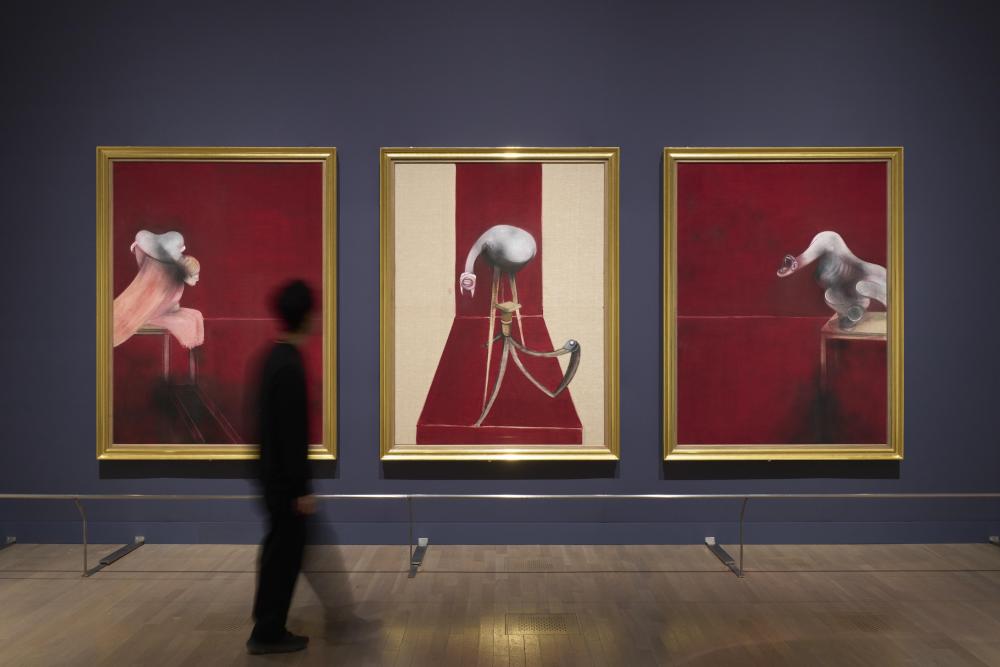
Francis Bacon, Second Version of Triptych 1944, 1988, Oil paint and acrylic paint on 3 canvases, Each: 198 × 147.5 cm
Installation view of the exhibition “YBA&BEYOND: British Art in the 90s from the Tate Collection”
The National Art Center, Tokyo, 2026
Photo: Osamu Sakamoto
CHAPTER 1: BROKEN ENGLISH: A NEW GENERATION
In the late 1980s, the social gap in the UK widened due to the neoliberal economic policies promoted by the Thatcher government since 1979. Against this backdrop, a new generation of artists emerged, sharply critiquing notions of "Britishness" by drawing on mass media and popular culture.
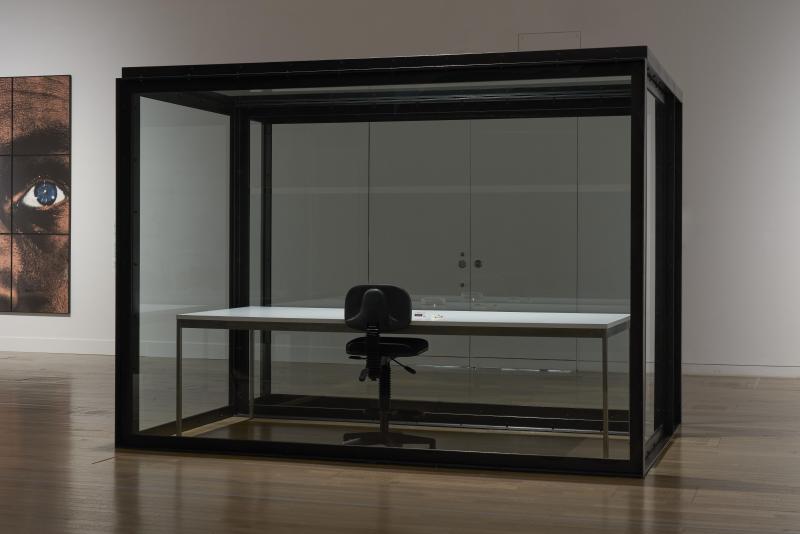
Damien Hirst, The Acquired Inability to Escape, 1991, Glass, steel, silicone rubber, Formica, fibreboard,chair, ashtray, lighter and cigarettes, 213.4 × 304.8 × 213.4 cm
Installation view of the exhibition “YBA&BEYOND: British Art in the 90s from the Tate Collection”
The National Art Center, Tokyo, 2026
Photo: Osamu Sakamoto

Lubaina Himid, Between the Two My Heart is Balanced, 1991, Acrylic paint on canvas, 121.8 × 152.4 × 2.7 cm
Photo: Tate © Lubaina Himid. Courtesy Hollybush Gardens and Greene Naftali
SPOTLIGHT: HANDSWORTH SONGS
Handsworth Songs was produced in response to riots that erupted in Birmingham's Handsworth district in 1985, following tension related to inequality and perceptions of police bias against minority (and particularly Black) communities. Broadcast as part of Channel 4’s series Britain: The Lie of the Land, the film blends sound and image in a layered, poetic fusion of documentary and experimental cinema that invites multiple interpretations.
**This work is screened at the following times. (Duration: 61 min.)**
[Mondays, Wednesdays, Thursdays and Sundays] 10:20/11:30/12:40/13:50/15:00/16:10
[Fridays and Saturdays] 10:20/11:30/12:40/13:50/15:00/16:10/17:20/18:30
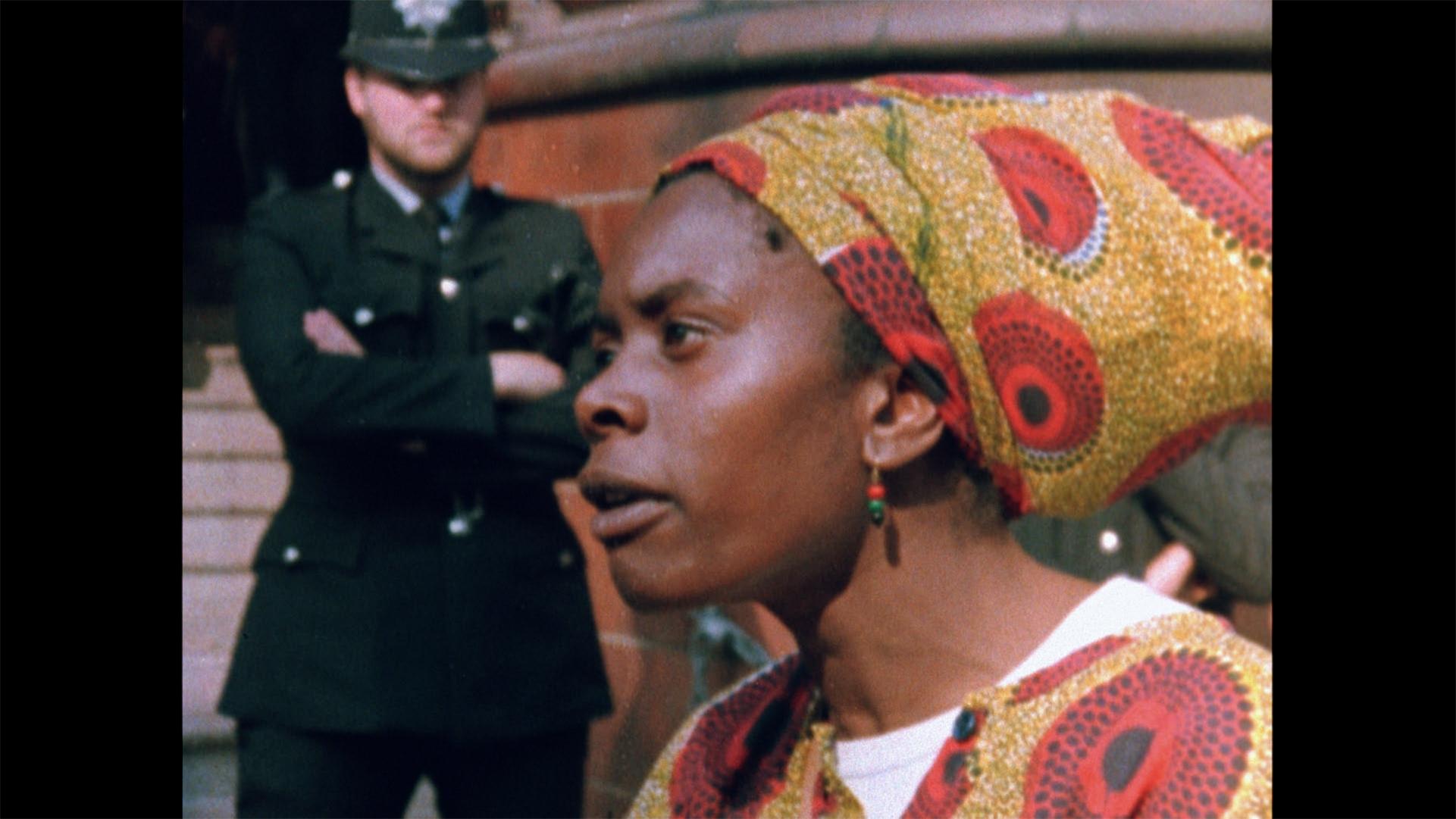
Black Audio Film Collective (John Akomfrah; Reece Auguiste; Edward George; Lina Gopaul; Avril Johnson; David Lawson; Trevor Mathison), Handsworth Songs, 1986, Film, 16 mm, or video, projection, colour and sound (mono), Duration: 61 min.
© Smoking Dogs Films; Courtesy Smoking Dogs Films and Lisson Gallery
CHAPTER 2: THE GREAT BEAR: PICTURING THE CITY
By the early 1990s, economic disparity had resulted in a growing number of unfinished buildings and the displacement of communities through gentrification. For young artists, these were familiar, everyday scenes—and also sources of inspiration to confront the urgent realities around them.
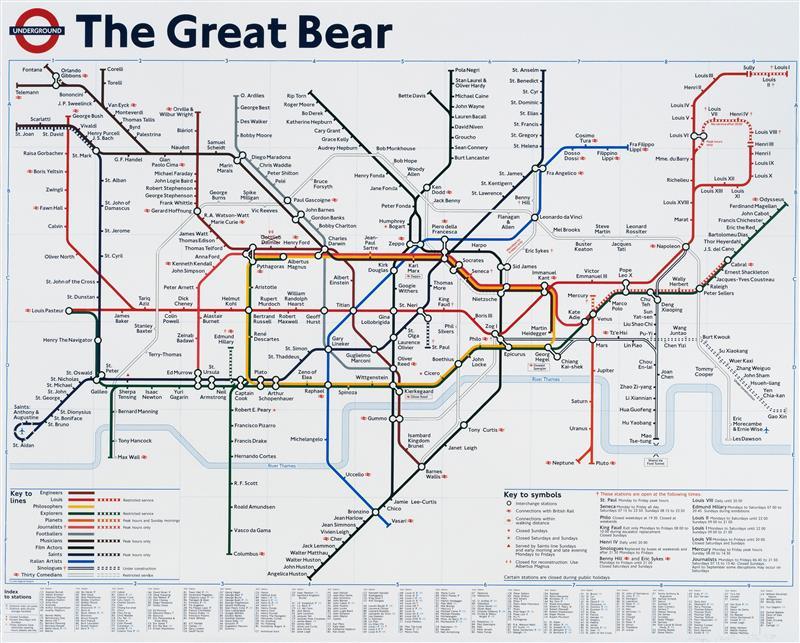
Simon Patterson, The Great Bear, 1992, Lithograph on paper, 102.7 × 128 cm
Photo: Tate © Simon Patterson and Transport for London
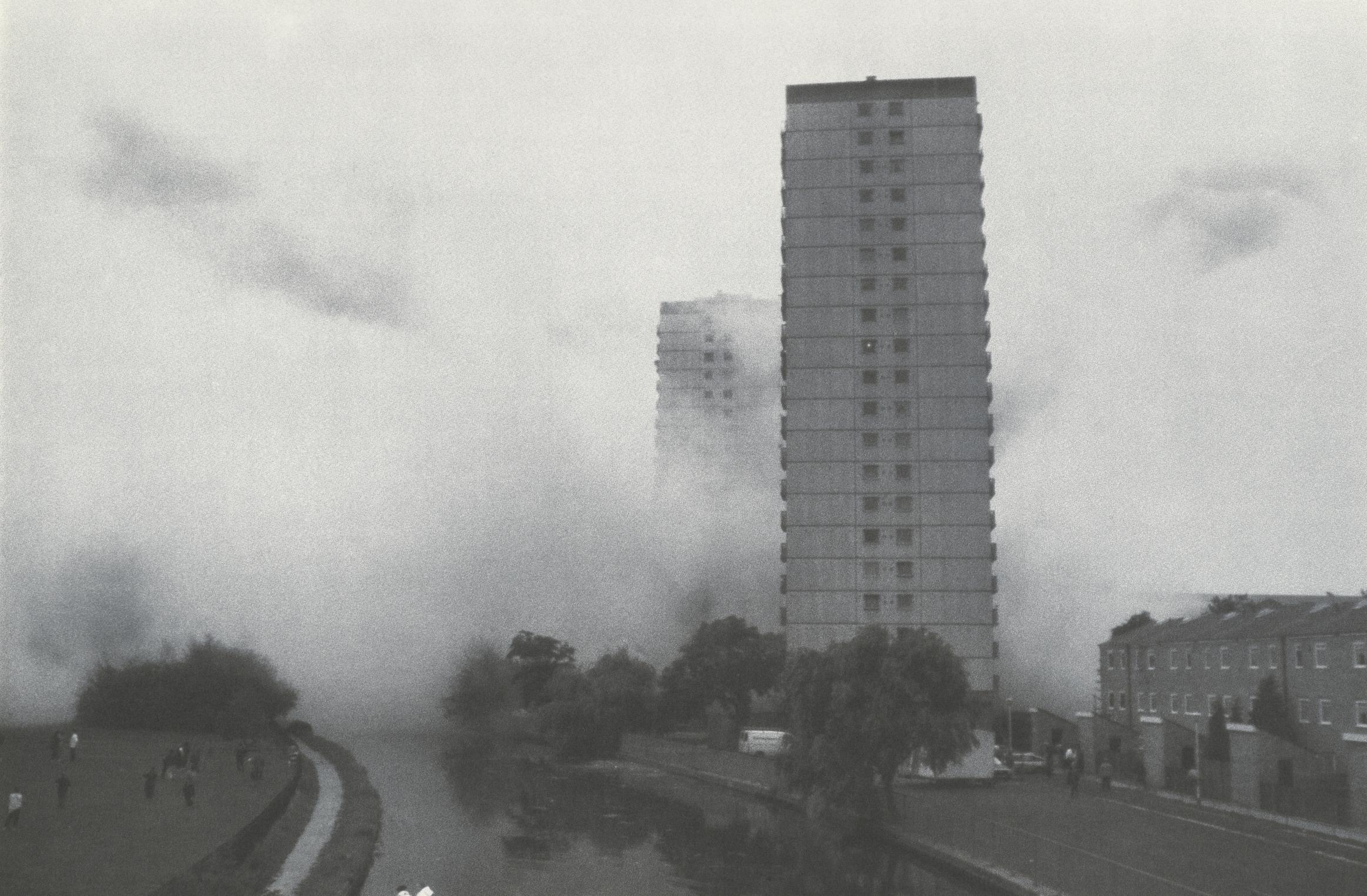
Rachel Whiteread, A: Clapton Park Estate, Mandeville Street, London E5; Ambergate Court; Norbury Court; October 1993, 1996, Screenprint on paper, 49 × 74.3 cm
Photo: Tate © Rachel Whiteread
CHAPTER 3: EVERYBODY IN THE PLACE: MUSIC, SUBCULTURE AND STYLE
In a time marked by inequality and uncertainty, artists turned to the visual dynamism of magazines and advertisements, the liberating energy of music, and the expressive power of fashion as essential elements in capturing fleeting moments and forming social bonds. These intersections helped propel the international visibility of British art in the 1990s.
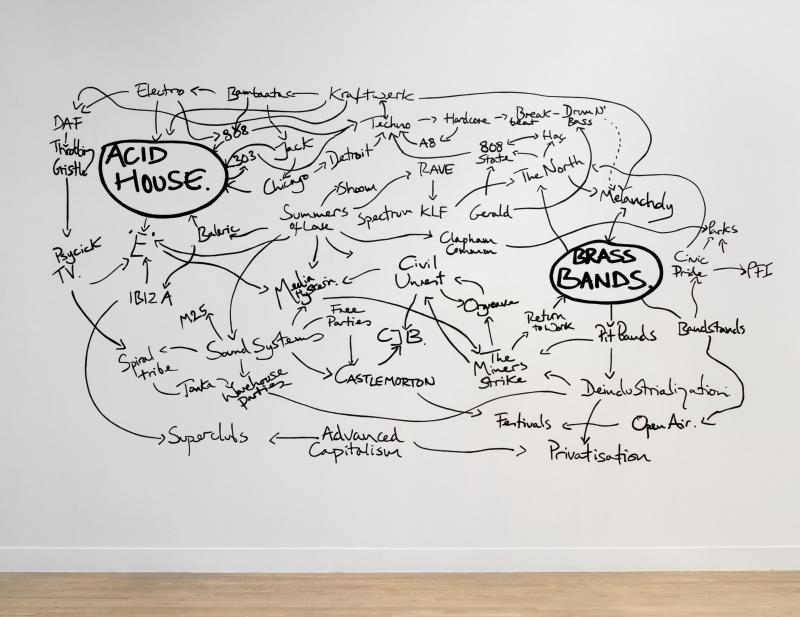
Jeremy Deller, The History of the World, 1997–2004, Graphite and acrylic paint on wall, Overall display dimensions variable
Photo: Tate © Jeremy Deller

Mark Leckey, Fiorucci Made Me Hardcore, 1999, Video, projection, colour and sound, Overall display dimensions variable, Duration: 14 min., 45 sec.
© Mark Leckey. Courtesy the artist and Cabinet, London
SPOTLIGHT: WHY I NEVER BECAME A DANCER
The first section of this video piece is set in Margate, the seaside town where Emin grew up, and recounts her painful teenage years in the late 1970s. Her candid reflections on humiliation and vulnerability offer deep emotional resonance—particularly for young women whose sense of dignity has been threatened. The second part shows an adult Emin dancing joyously to a well-known disco song by the recording artist Sylvester, powerfully suggesting her triumph over the pain experienced in her earlier life.

Tracey Emin, Why I Never Became a Dancer, 1995, Film, super 8 mm, shown as video, projection, colour and sound (mono), Duration: 6 min., 32 sec.
© Tracey Emin
CHAPTER 4: MODERN MEDICINE
For artists of the 1990s, advances in science, medicine and healthcare became pressing themes. Concerns ranged from trust in pharmaceuticals and the regulation of bodies within medical systems. The spread of HIV and the rise of AIDS-related deaths generated widespread fear, anger, and resistance—fuelling artistic responses across the UK.
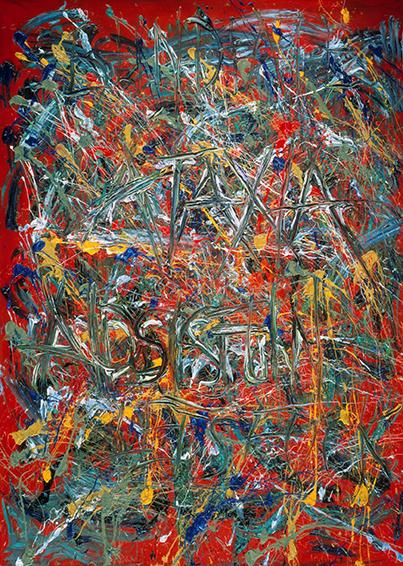
Derek Jarman, Ataxia - Aids is Fun, 1993, Oil paint on canvas, 251.5 × 179 × 3.6 cm
Photo: Tate © The estate of Derek Jarman. Courtesy of The Keith Collins Will Trust
SPOTLIGHT: BEAR
Bear, one of McQueen’s early breakthrough works, is a silent black-and-white film shown in a darkened gallery on a large screen. In the film, two naked Black men—one of them McQueen himself—engage in ambiguous gestures that oscillate between playfulness and confrontation. Although no explicit message is stated, the imagery evokes questions around race, desire, masculinity, and violence. The installation immerses the viewer, making them a participant in the unfolding tension.
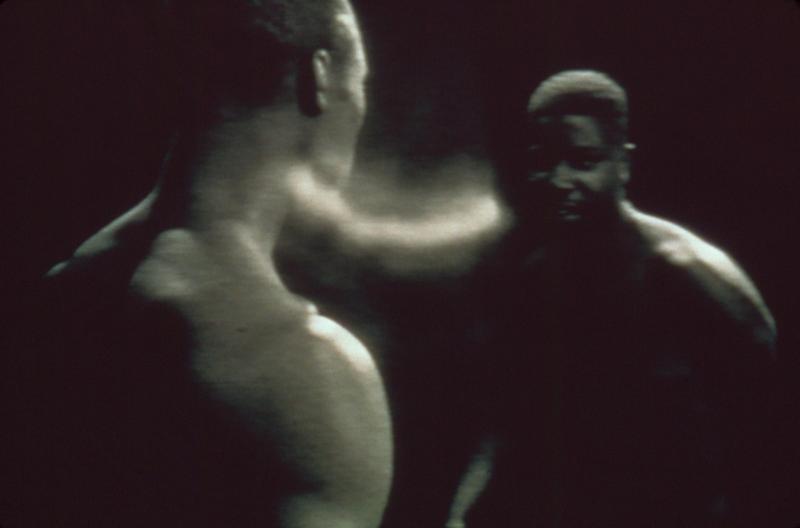
Steve McQueen, Bear, 1993, 16 mm black-and-white film, transferred to video, no sound, Duration: 9 min., 2 sec.
© Steve McQueen. Courtesy the artist, Thomas Dane Gallery and Marian Goodman Gallery
CHAPTER 5: AT HOME: PERSONAL SPACES
For many young artists, the private realm of the home became a politically charged site. Family relationships and personal identity were central themes, explored through works that expose domestic violence, social power imbalances, and resistance to patriarchy—resonating powerfully with contemporary viewers.
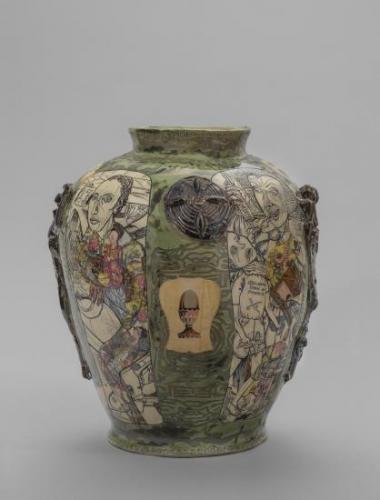
Grayson Perry, My Gods, 1994, Earthenware, 40 × 34.5 × 33 cm
© Grayson Perry. Courtesy the artist and Victoria Miro
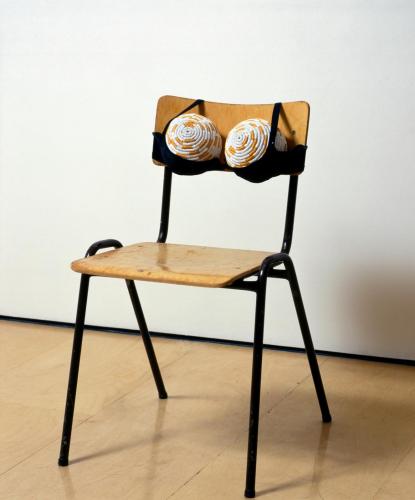
Sarah Lucas, Cigarette Tits (Idealized Smokers Chest II), 1999, Chair, balls, cigarettes and bra, 78.7 × 49.5 × 52.7 cm
© Sarah Lucas. Courtesy Sadie Coles HQ, London
SPOTLIGHT: COLD DARK MATTER: AN EXPLODED VIEW
This early work by Cornelia Parker consists of everyday objects—dishes, bricks, instruments—suspended from the ceiling. To create the piece, she enlisted the British Army to blow up a garden shed. She then collected the fragments, hung them from wires, and installed a bright light at the centre of a darkened gallery space. The result is a three-dimensional "exploded view"—a freeze-frame of destruction and suspension.
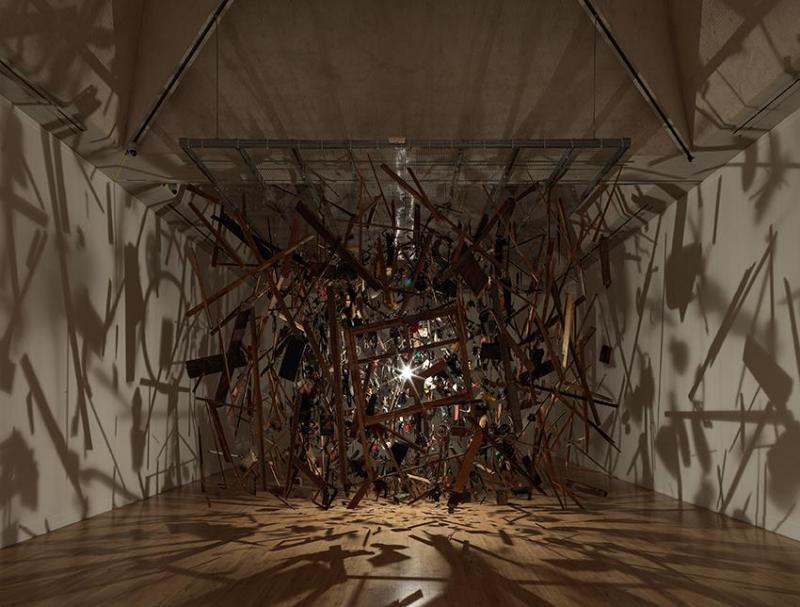
Cornelia Parker, Cold Dark Matter: An Exploded View, 1991, Wood, metal, plastic, ceramic, paper, textile and wire, Dimensions variable between 400 × 500 × 500 cm
Photo: © Tate © Cornelia Parker. Courtesy Frith Street Gallery
CHAPTER 6: SOMETHING FROM NOTHING: THE QUOTIDIAN OBJECT
Many artists in the 1990s turned their attention to the material world, incorporating fragile and ephemeral objects from daily life into their work. This shift was, in part, a reaction against the large-scale minimalism of 1980s conceptual art, which seemed ill-equipped to capture the subtleties of contemporary life.
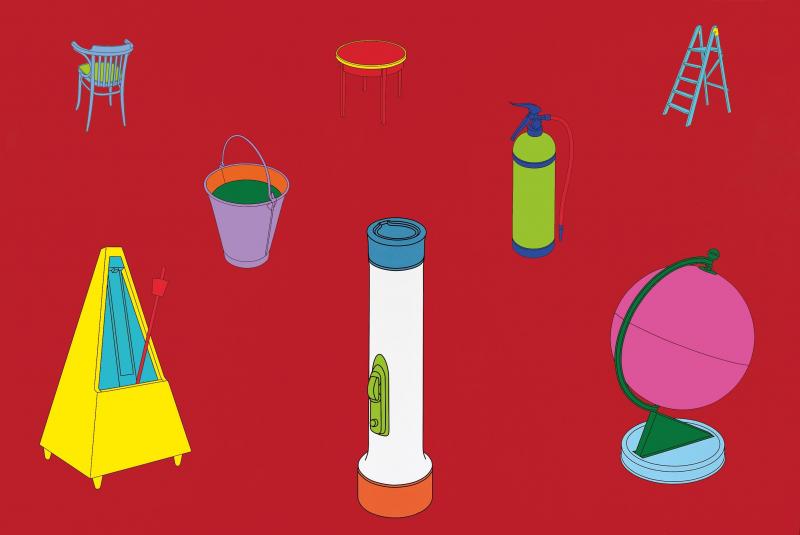
Michael Craig-Martin, Knowing, 1996, Acrylic paint on canvas, 244.2 × 366.5 cm
© Michael Craig-Martin. Courtesy the artist and Gagosian
SPOTLIGHT: THRESHOLD TO THE KINGDOM
In Threshold to the Kingdom, filmed in slow motion at the arrivals gate of London City Airport, the soundtrack features Miserere, a choral piece composed by Gregorio Allegri based on Psalm 51. Wallinger’s video casts the airport as a space loaded with political and symbolic meaning, as the border zone of an actual kingdom (the UK) and the threshold to a symbolic kingdom.